- Four-part structure: hook, idea, proof, action.
- 60 seconds is roughly 130 to 150 spoken words.
- Write the way you talk: short sentences, one idea per line.
- Ask for one single action at the end.
How many words for a 60-second video?
When speaking at a calm pace, people say about 130 to 150 words per minute. Aim for around 70 words for a 30-second video and about 200 for 90 seconds. If your script is longer, do not speak faster: cut.
The four-part structure
- The hook (0 to 3 seconds)
A promise, a surprise or a question about a specific problem. No “Hi, my name is…”: get straight to the point.
- The idea (3 to 40 seconds)
One message, explained simply. If you have three ideas, make three videos.
- The proof (40 to 50 seconds)
An example, a number, a before/after or a short story. This is what makes the advice believable.
- The action (last 10 seconds)
One clear request: “Save this video”, “Try it tomorrow morning”, “Comment GUIDE”.
The template to copy
[Hook] Still doing [common mistake]?
That’s why [problem].
[Idea] The fix is simple:
[your advice in one sentence].
[Proof] Since I started doing this,
[concrete result].
[Action] Try it today
and tell me in the comments if it works.
7 hooks that work
- “Stop [habit] if you want [result].”
- “Nobody told me this before I started [something].”
- “What [number] years of [job] taught me, in 60 seconds.”
- “The free trick that changed my [videos / sales / mornings].”
- “You are probably making this mistake without knowing it.”
- “If you [specific situation], this video is for you.”
- “Before and after: here is what changed everything.”
Write five different hooks for the same video, read them aloud and keep the one that makes you want to watch what comes next.
Write to be heard, not to be read
Text written for a document sounds stiff on camera. Stay conversational: sentences under 15 words, simple words, no brackets. Start a new line at every breath: on a teleprompter, those line breaks become your natural pauses.
Then read it aloud with a timer. Every time you stumble, rewrite the sentence instead of practising it.
Full example: a plumber on Instagram
Your tap still drips
even after changing the washer?
The problem usually isn’t the washer.
It’s the cartridge.
Last week at a client’s home,
we replaced three washers for nothing.
A twelve-dollar cartridge fixed it.
So before buying more washers,
check the cartridge.
And save this video for the next leak.
Adapting one script to each platform
Keep one master script, then make versions: 30 seconds for TikTok and Reels (hook + idea + action), 60 to 90 seconds with the proof, and a long version for YouTube with several examples. Do not read faster to squeeze the same text in: cut the content.
From script to video, without stumbling
Once your script is ready, do not memorise it. Display it close to the lens and read it while looking at the camera. Rehearse once, then record two or three short takes.
FAQ
How do I write a good video script?
Follow four steps: a hook in the first three seconds, one idea explained simply, a proof (example, number, story) and one single action at the end. Write short sentences meant to be spoken.
How many words is a one-minute video?
About 130 to 150 words at a calm pace. Count about 70 words for 30 seconds and about 200 for 90 seconds.
Do I need a script for TikTok or Reels?
Yes, even a short one. A few lines save time during the shoot and make your hook much stronger.
Can I write a video script with AI?
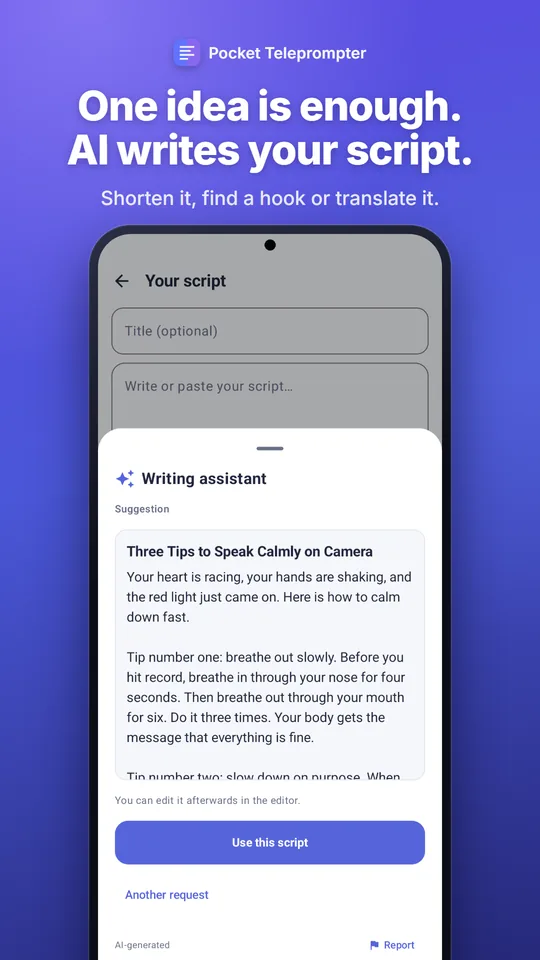
Yes. Pocket Teleprompter’s AI assistant drafts a script from an idea; you then read it over and adjust it to the way you speak before filming.