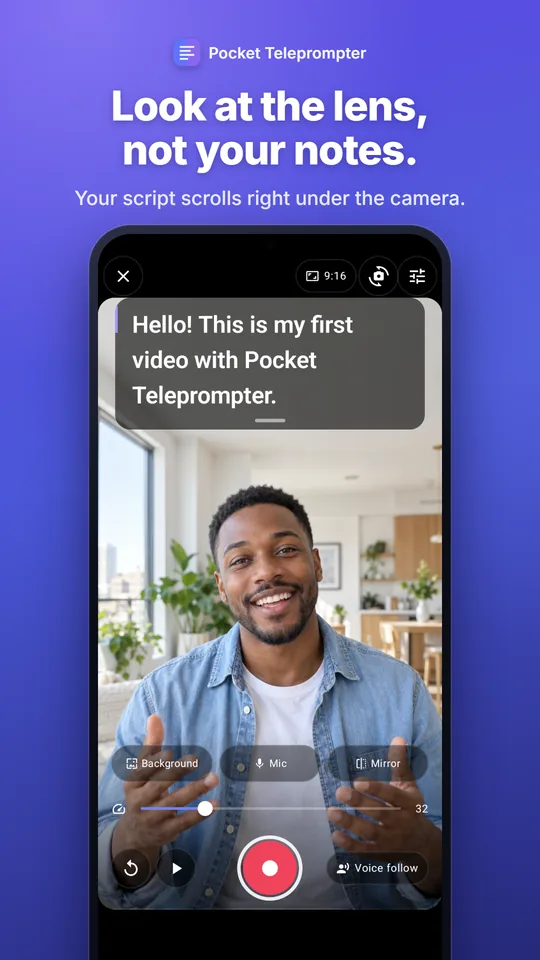
- Lens at eye level, or a little above. Never below.
- Distance depends on your framing: the further back you are, the more natural your eyes look.
- Look at the lens, not at yourself: keep the text right under the lens.
- Glasses: move the light to the side and lower the screen brightness.
Height: the lens at eye level
Find your phone’s lens (the small circle at the top of the screen for the front camera), then raise or lower the phone until it sits at the height of your eyes. You then look straight into the camera, the way you look at someone across the table.
- Phone too low (on the table, or held at stomach height): people see you from below, your chin and nostrils take over, and the ceiling shows behind you.
- Phone slightly above your eyes: a flattering angle, your eyes lift a little. It is often the most flattering setting.
- Phone far too high: you look up and seem small, like a security camera shot.
Sitting and standing are not the same. Set the height in the exact position you will speak in, not before you sit down.
Distance for each framing
There is no single right distance: it depends on what you want to show. These are starting points for a phone’s front camera in vertical video; test and adjust.
- Face and shoulders (the most common for TikTok, Reels and Shorts): the phone about an arm’s length away.
- Chest up, hands visible: step back, to about one and a half metres (five feet). Ideal if you talk with your hands.
- Wider shot (waist up or full body): two metres (six feet) or more, on a tripod. The built-in mic gets weaker with distance, so a lavalier mic becomes useful.
Too close, the wide-angle front lens distorts: your nose looks bigger and your face rounder. Stepping back a little gives a more natural face.
Looking at the lens while you read
Viewers feel you are looking at them when you look at the lens, not at your own image in the middle of the screen. So if you read a script, it should sit as close to the lens as possible, so your eyes barely move.
- A narrow column: your eyes travel less from left to right.
- Slightly smaller text: more words fit near the lens and your eyes drop less.
- More distance: at one or two metres, a small eye movement is hard to notice. You then need text big enough to read: try it.
- A comfortable speed: if the text runs too fast, you chase it with your eyes and it shows.
Front or back camera?
To read your script while filming yourself alone, use the front camera: you see the screen, and so your text, next to the lens. The back camera often gives a better picture, but the screen then faces away from you and you can no longer see your text. It suits filming without a script, or with a mirror teleprompter (a glass in front of the lens), which needs mirrored text.
No tripod? Ideas from around the house
- A stack of books on a table or a chest of drawers, with the phone wedged against something heavy.
- A shelf at the right height: often the steadiest option when you stand.
- A desk phone stand set on a box or books to gain height.
- A phone tripod with a clamp: the easiest way to set the exact height and film standing up.
Avoid holding the phone in your hand for a talking-head video: the picture shakes, your arm gets tired and the distance keeps changing.
Glasses and glare
With glasses, the light and the phone screen can reflect in the lenses. A few changes often fix it:
- Put the lamp or window slightly to the side, not exactly behind the phone.
- Lower the brightness of the phone screen: it is often the screen that reflects while you read.
- Tilt your glasses down very slightly, or raise the phone a little.
- Watch your test: if the glare hides your eyes, move the light until it disappears.
The 10-second test
- Get in position as for the real video
Sitting or standing, at your distance, with the light on.
- Record one sentence while reading your script
Look at the lens as if you were talking to someone.
- Watch it back
Chin, framing, eye line, glare. If your eyes visibly drop, lower the text width and height, or step back a little.
FAQ
Where should I place my phone when filming myself?
Put it on a steady support with the lens at eye level, or a little above. Lower, people see you from below with your chin and nostrils forward; much higher, you look small.
How far should the phone be when filming yourself?
About an arm’s length for face and shoulders, about one and a half metres for chest up with your hands, two metres or more for a wide shot on a tripod. Do a test and adjust.
How do I keep eye contact while reading a script?
Show the text right under the lens in a narrow column, and look at the lens rather than your image. A teleprompter such as Pocket Teleprompter scrolls the text under the camera while you record.
Should I use the front or back camera to film myself?
To read a script while filming yourself alone, use the front camera, because you can see the screen. The back camera often looks better, but you can no longer see your text, unless you use a mirror teleprompter.